

DFG Emmy-Noether “OXYGEDOM” project of Dr. Gonzalo V. Gómez Sáez
DFG Emmy-Noether “OXYGEDOM” project of Dr. Gonzalo V. Gómez Sáez
Seawater stores as much carbon in the form of dissolved organic matter (DOM) as there is carbon dioxide (CO2) in the atmosphere. Due to its great size, shifts in reactivity of the marine DOM pool strongly impact global biogeochemical cycles. ?Microbial metabolisms in the oceans are directly responsible for the production, degradation and recycling of DOM, but little is known about how the complex pool of DOM shapes microbial communities and vice versa.
At the "Biogeochemistry & Climate Change" group of Dr. Gomez-Saez, a combination of state-of-art techniques in analytical chemistry and microbial ecology are used to experimentally investigate biogeochemical interactions between microbes and DOM in the context of deoxygenation and warming, two of the major side effects of climate change in the ocean:
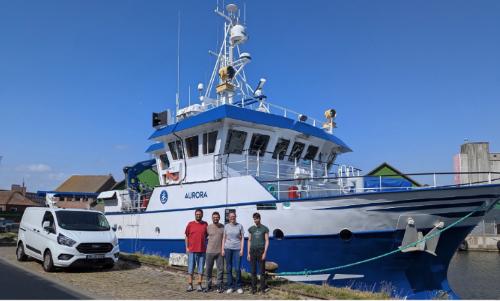
Group picture of the DFG Emmy-Noether research group in Biogeochemistry & Climate Change, after scientific expedition onboard RV Aurora in August 2025. From left to right: Gonzalo Gomez-Saez, Ömer Coskun, Marit Renken, Laurin Lidl.
Copyright: Gonzalo Gomez-Saez
Deoxygenation effects on DOM sequestration in a changing ocean:
Over a period of just 50 years (from 1960 to 2010) global oceanic oxygen reserves have been reduced by 2% and the anoxic waters have quadrupled, mainly due to anthropogenic global warming and eutrophication. Ocean deoxygenation leads to an expansion of oxygen minimum zones (OMZs), which contain higher concentrations of DOM (carbon and sulfur) than the oxygenated ocean. Recent advances in analytical chemistry characterize the DOM at the molecular level in unprecedented detail, revealing new insights into its source and history by Fourier transform ion-cyclotron resonance mass spectrometry (FT-ICR-MS). Current progress in sequencing technology can predict specific functions contributing to the molecular activity of microbial communities in environmental samples by metatranscriptomics. The synergistic coupling of FT-ICR-MS and metatranscriptomics is therefore of great importance to connect DOM cycling with microbial activities in OMZs. Our aim in this research topic, funded by the German Research Foundation (DFG) as an Emmy-Noether Research Group, is to identify the effects of ocean deoxygenation on DOM sequestration due to interactions with microbial communities and the marine carbon and sulfur cycles.
Organosulfur cycling by active uncultivated microbes:
In marine sediment, organosulfur compounds represent a significant fraction of organic matter with a key role in carbon sequestration. In coastal and marine OMZs, microbial communities play a key role in the production, degradation and transformation of dissolved organic sulfur (DOS) compounds. While the cycling of inorganic sulfur has been widely studied, the microbial diversity involved in the cycling of DOS remains largely unknown. We investigate the cycling and microbial reactivity of key organosulfur compounds - such as taurine and methionine - in marine sediments and OMZs. Using quantitative DNA stable isotope probing (qSIP) with labeled DOS substrates (e.g. 13C-taurine), we aim to target the main active microbes driving organosulfur cycling in the ocean. This research is conducted as part of the DFG Emmy-Noether research group, in collaboration with the Geomicrobiology group of Prof. William Orsi at LMU and GeoBio Center.
Deoxygenation effects on microbial element cycling in the Mariager Fjord
Deoxygenation in Danish waters is an increasing problem with 2023 experiencing the most severe anoxia in 20 years. Mariager Fjord is the longest fjord in Jutland and the second longest fjord in Denmark. Due to nutrient loading from land combined with its topography, Mariager Fjord has anoxic bottom waters between spring and late fall, but is typically flushed with oxygen-rich seawater from the Kattegat during winter. This research topic was part of the DeoxyMar scientific expedition supported by DCH (Denmark). It involved a ship transit from Aarhus Bay to Mariager Fjord and the Kattegat open waters in August 2025, onboard the research vessel RV Aurora with Dr. Gomez-Saez as Chief Scientist. Our aim is to provide a mechanistic and quantitative understanding for microbial element cycling interactions under varying levels of deoxygenation. Together with LMU, cooperation partners in the DeoxyMar project include universities and research centers from Denmark (Center for Electromicrobiology from Aarhus University, University of Southern Denmark SDU from Odense) and Sweden (University of Goteborg).
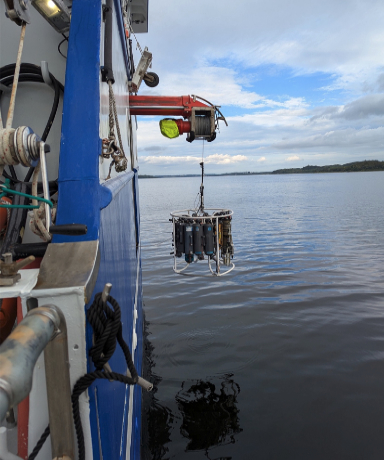
CTD cast during oceanographic expedition to collect water column samples
from specific depths within the oxygen minimum zone.
Copyright: Gonzalo Gomez-Sae
Warming effects on Antarctic microbes and organic matter cycling
Last report of IPCC clearly stated that nowhere is climate change more visible than in the polar regions, making them the most critical reference regions for the detection and understanding of global change and its effects on biodiversity and ecosystem functioning. The polar biome is a highly connected ecosystem with linkages all over its components and beyond. However, can we consider the Antarctic region an early warning site? With atmospheric CO2 concentrations and global temperature rising in the next few decades, the ocean will become warmer, less oxygenated and more stratified. The lack of knowledge about environmental drivers behind microorganisms and DOM pool functioning in response to these changes, especially in polar regions, limits our capacity to understand and predict the consequences of human activities and its associated global effects. This research topic includes samples obtained from the NEIGE project, with field and experimental work in Antarctica performed in December 2023 onboard the National Geographic Explorer by Dr. Gomez-Saez and the other Co-PI of the project, Dr. David Velázquez (UAM, Madrid, Spain). Both researchers were "Visiting Scientists" with funds from Lindblad Expeditions and National Geographic.
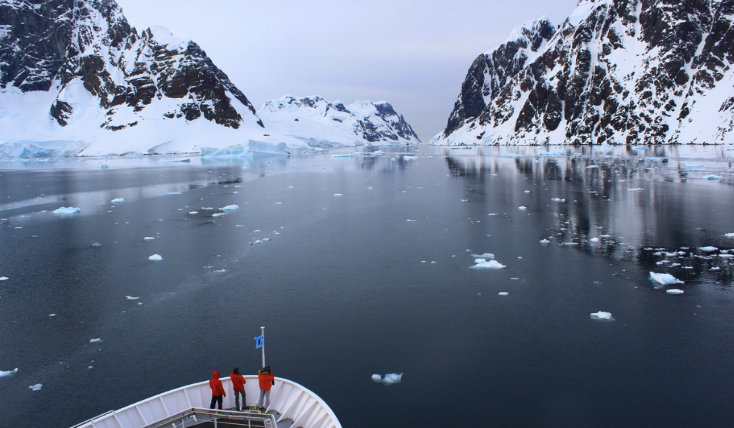
Heading into the Lemaire Channel at 65° South, Antarctica.
Copyright: Gonzalo Gomez-Saez
Key publications:
Gomez-Saez GV, Dittmar T, Holtappels M, Pohlabeln AM, Lichtschlag A, Schnetger B, Boetius A, Niggemann J (2021). Sulfurization of dissolved organic matter in the anoxic water column of the Black Sea. Science Advances 7 (25), eabf6199. DOI: 10.1126/sciadv.abf6199
Coskun ÖK, Orsi WD, D´Hondt S, Gomez-Saez GV (2025)
Identifying the active microbes driving organosulfur cycling from taurine and methionine in marine sediment.
ISME communications, ycaf033. DOI: 10.1093/ismeco/ycaf033.
Press release:
LMU press: https://www.lmu.de/en/newsroom/news-overview/news/polar-research-warming-in-the-cooler.html